Pilot projects · HSCAM STREAMER
STREAMER 1M13 — available nowMake sporadic machine faults visible.
Together we check whether continuous high-speed recording and synchronized measurement signals can help find the cause of your process problem.
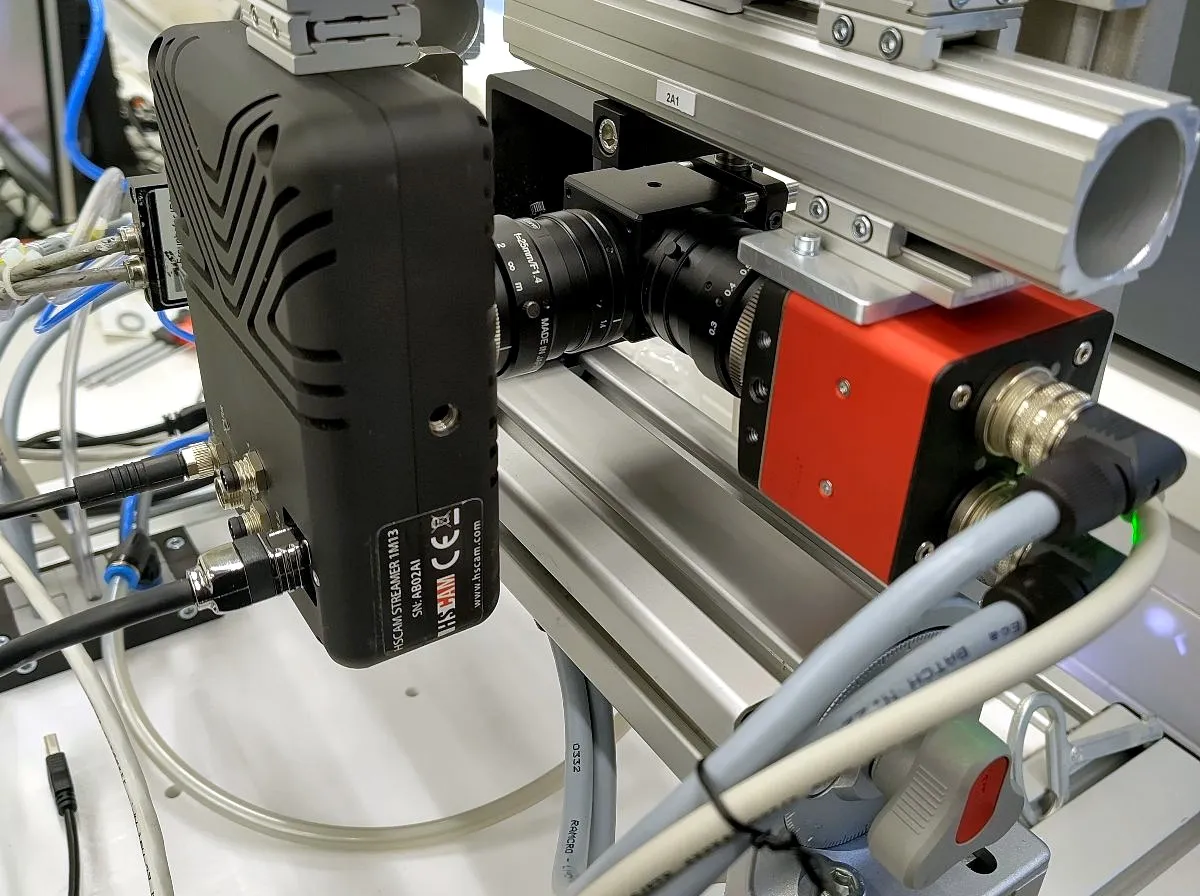
Where it fits
Typical starting points
These are examples, not a checklist. If your situation is similar, describe it and we will tell you honestly whether recording looks promising.
-
01
A fault is rare
It occurs only now and then and can hardly be reproduced in a planned trial.
-
02
A signal deviates, the cause is unclear
A measurement signal shows a deviation, but the mechanical cause stays open.
-
03
A fast sequence is not visible enough
The process is too fast to be recognized properly in the footage you already have.
Documented application
Steel and rolling mill: cuts and wire jams recorded around the clock, with synchronized measurement data. One problem there: if the feed of a shear does not match, the steel misses the exit, a flap opens, a limit switch trips and the line stops.
See the steel-mill applicationPossible uses, not installations
The same kind of problem can occur in other industries. For these, HSCAM has not documented an installation; suitability is checked in your specific setup.
Further example
Marker tracking and motion amplification on high-speed recordings: an evaluation study for vibrating machines, with a trajectory and amplified motion shown beside the original image.
Marker Tracking & Motion AmplificationRecorded example
What a recording can show
A real HSCAM recording of a high-speed shear, with what belongs to it and what does not.
HSCAM recording of a high-speed shear in a steel mill, 10,702 fps
- Recorded at
- 10,702 fps
- Image size
- 1,024 × 104 px
- Played at
- 15 fps · ≈710× slower
Recorded by HSCAM in a steel mill. Slow-motion playback, not real time. The excerpt ends with the first cuts; more recordings are on the steel-mill application page.
- What is shown
- A glowing wire approaching a shear, from the start of the recording up to the first cuts, recorded with an HSCAM camera.
- What becomes visible
- How the steel moves on contact with the shear, which can be followed frame by frame in slow motion.
- Frame rate and image area of this recording
- 10,702 fps at 1,024 × 104 px, as shown in the viewer overlay of the clip.
- Movement per frame
- At a wire speed of 120 m/s, the wire moves about 11 mm between two frames at 10,702 fps (120 m/s ÷ 10,702 fps = 11.2 mm). At 4,041 fps it would be about 30 mm.
- What this clip does not show
- It is not a real-time recording and has no measurement curve. These values belong to this clip only and say nothing about what your process needs.
How it works
From problem description to pilot
Four steps. You decide after each one whether to continue.
-
1. Describe process and problem
You tell us what the process does and what goes wrong. A short description is enough.
-
2. Check technical suitability
Together we look at line of sight, speed, image area, lighting, signals and environment.
-
3. Plan a limited test
Scope, time frame and costs of the test are agreed together before anything starts.
-
4. Evaluate and decide
We go through the recordings with you and decide on the next step.
Scope, time frame and costs are agreed individually for each test.
Outcome
What an agreed test delivers
The exact scope is defined together for each project. It can include:
- Recordings of the agreed process.
- An assessment of whether relevant events are visible and distinguishable.
- A proposal for a follow-up or permanent setup.
A test shows what recordings can and cannot reveal in your setup. It does not promise that a cause is found or a fault is removed.
Prerequisites
What we need from your side
Not everything has to be settled up front. Open points are clarified in step 2.
- A view of the relevant section of the process.
- Room to mount the camera and lighting.
- A contact person who knows the process.
- Access to the machine or to a suitable test setup.
- If needed: the trigger or measurement signals that are available.
Frame rate and image area do not have to be known when you get in touch.
Integration projects · HSCAM NANO
Prototype — for evaluation and pilot projectsImage-based triggering on the camera
For customer-specific integration projects: image-based triggering and processing on the camera itself. NANO is a separate product from STREAMER and is not yet a catalog product.
- Image-based triggering derived directly from image content on the sensor chip.
- Region of interest selected on the chip.
- Object coordinates instead of full frames as output, for minimal bandwidth.
- Standalone operation without a host PC through the M8 connector.
Development status: prototype. STREAMER 1M13, above, is the product available today.
Request an application review
Describe what goes wrong in your process or what you need to see. HSCAM reviews your details and gets back to you to put the problem into technical context.
Helpful, but not required
- What your process does and what goes wrong, or what you cannot see today
- Speed or cycle time, if you know it
- Measurement or trigger signals that exist on the machine
- Environment: temperature, lighting, mounting space
contact@hscam.com · hscam.com