HSCAM STREAMER family — continuous USB 3.0 high-speed camera
Available nowHSCAM STREAMER 1M13
Monochrome high-speed camera that streams continuously over USB 3.0 — 1,318 fps at 1,280 × 864 px — with analogue and digital measurement channels recorded on the same clock as every frame.
Used for industrial process monitoring, synchronized multi-camera and sensor acquisition, and scientific instrumentation.
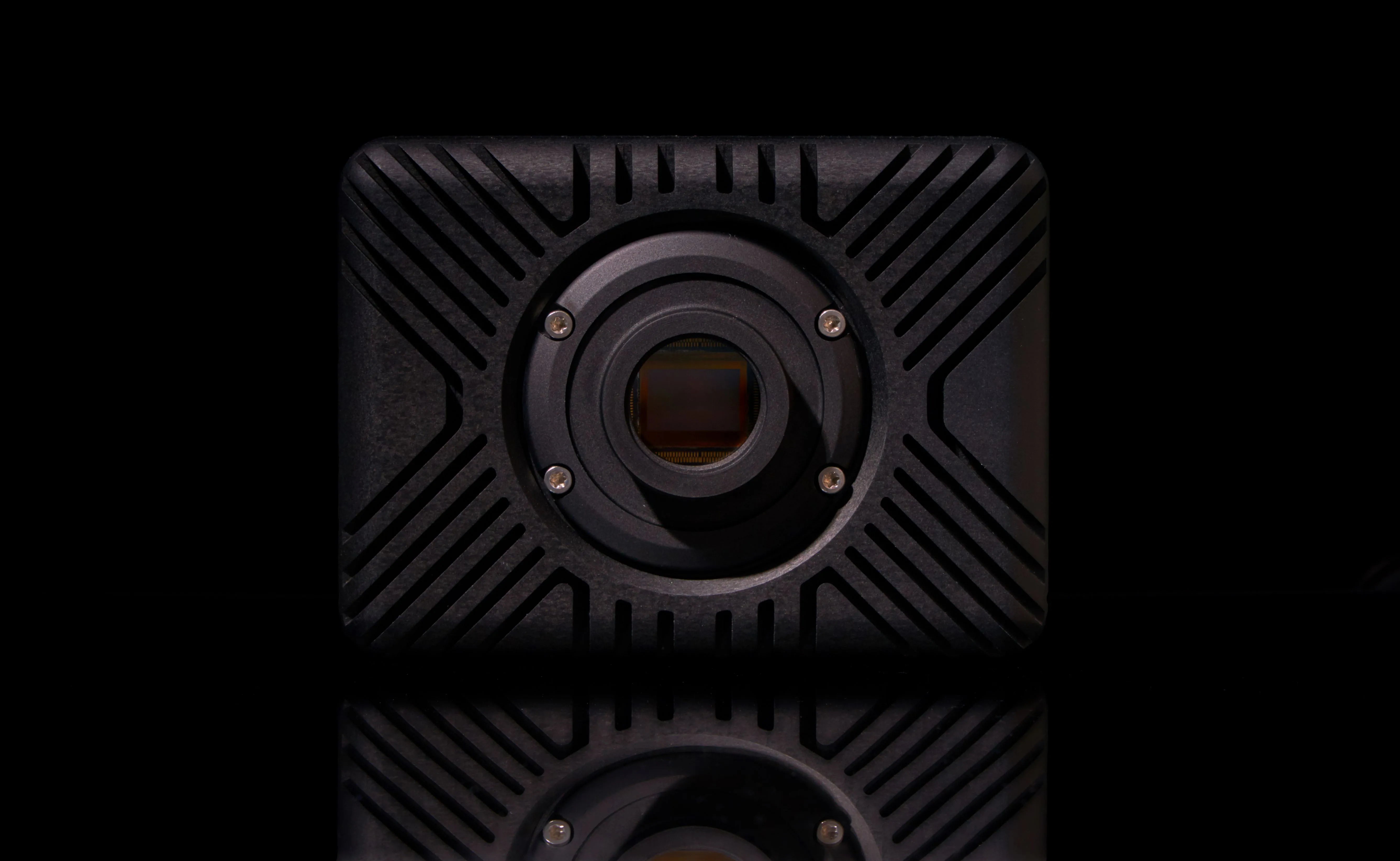
- Frame rate, full frame
- 1,280 × 864 px @ 1,318 fps continuous
- Frame rate, reduced ROI
- 1,280 × 4 px @ 168,000 fps continuous
- Minimum exposure time
- 1 µs
- Interface / data rate
- USB 3.0, up to ~300 MB/s
Recorded with STREAMER
A shear cut at 4,041 fps
A real recording of a wire cut on a high-speed shear, played back about 270 times slower. A narrower image area is what allows the higher frame rate.
Resolution, frame rate and compression rate are those of this recording. More footage is on the steel & rolling mill page.
Shear cut at 4,041 fps
- Frame rate
- 4,041 fps
- Image size (ROI)
- 1,024 × 280 px
- Played at
- 15 fps · ≈270× slower
- Compression rate
- ≈ 3.5
Differentiators
Continuous streaming, not a memory buffer
A typical high-speed camera trades recording time for frame rate: a trigger fills a short on-board memory buffer, then the camera goes quiet while it offloads. STREAMER 1M13 streams continuously over USB 3.0, so an unpredictable event does not need to be predicted in advance to be captured.
Continuous streaming
Designed for 24/7 operation over USB 3.0 and demonstrated around the clock in a steel-mill installation.
Edge-preserving compression
At 1,280 × 864 px and approximately 1,300 fps one camera generates ~1.44 GB/s. In-camera compression of about 5:1, which preserves edges, reduces this to ~300 MB/s for USB 3.0 and direct recording to a suitably specified SSD. The compression intensity is adjusted dynamically to prevent the camera's internal buffer from overflowing.
Triggered recording
Compression reduces the running data rate. A trigger additionally limits which periods are stored, for example while goods are present.
Synchronized measurement
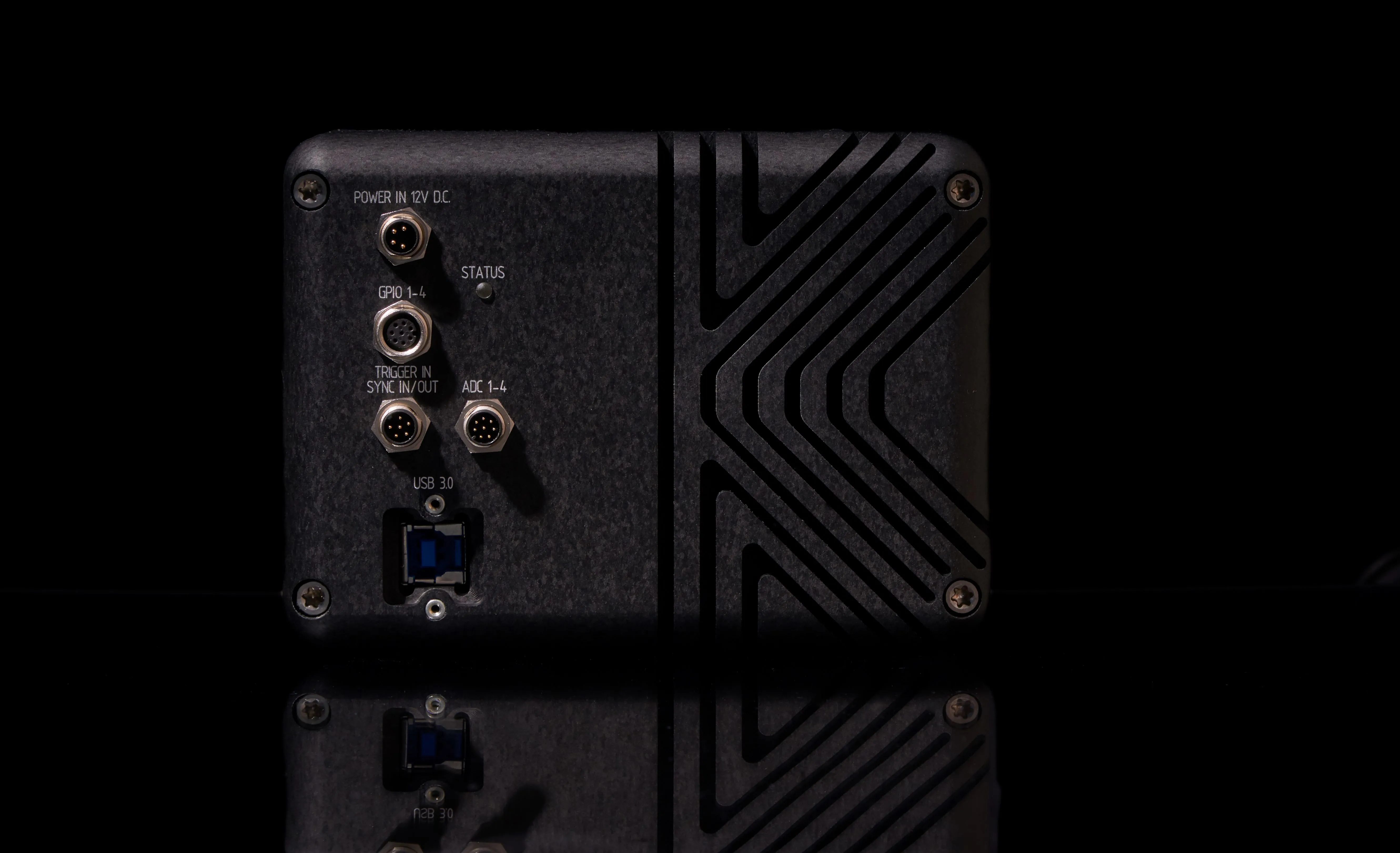
4× 16-bit ADC and 2× GPIO channels are captured on the same clock as every frame, so a measurement value can be tied to the exact image it belongs to.
Data path
From sensor to storage
A simplified view. Compressing in the camera is what makes sustained streaming realistic over a standard interface.
Sensor
1,280×864 px · ~1,300 fps · ~1.44 GB/s
On-camera compression
Edge-preserving, ~5:1
USB 3.0 interface
~300 MB/s
Host / storage
PC with a suitably specified SSD
Reading the numbers
Four numbers that are easy to confuse
Frame rate and ROI, exposure time, synchronization and latency describe different things.
- Frame rate and ROI
- Images per second for a given image area. A smaller region of interest gives a higher rate.
- 1,318 fps at 1,280 × 864 px · 168,000 fps at 1,280 × 4 px
- Exposure time
- How long each frame collects light. It sets the motion blur and is chosen separately from the frame rate.
- Minimum 1 µs · 100 ns – 3 µs with strobe lighting in the steel-mill installation
- Synchronization
- Time offset between a measurement sample and its video frame, and how much that offset varies (jitter). Synchronization is based on the camera’s internal 100 MHz clock.
- Example: 140 m/s × 10 ms offset = 1.4 m
- Latency
- Time from an event to a decision or reaction. It depends on where the processing happens.
- < 100 ms in the PC-based tiers · < 1 µs in the FPGA tier
Applications
Where this camera has been used
Three documented uses, each with its own page.
Industrial deployment
Steel & rolling mill process monitoring
Every cut and jam on a wire line at up to 140 m/s.
Trade-show demonstration
Synchronized video & measurement
1M13 and 1C13, triggered by an ADC threshold.
Research application
Realtime Droplet Inspection
Footage recorded at 8,000 fps to build an AI training set.
STREAMER 1M13 is also used in scientific instrumentation, for example in a Nitrogen Phosphorus Detector setup.
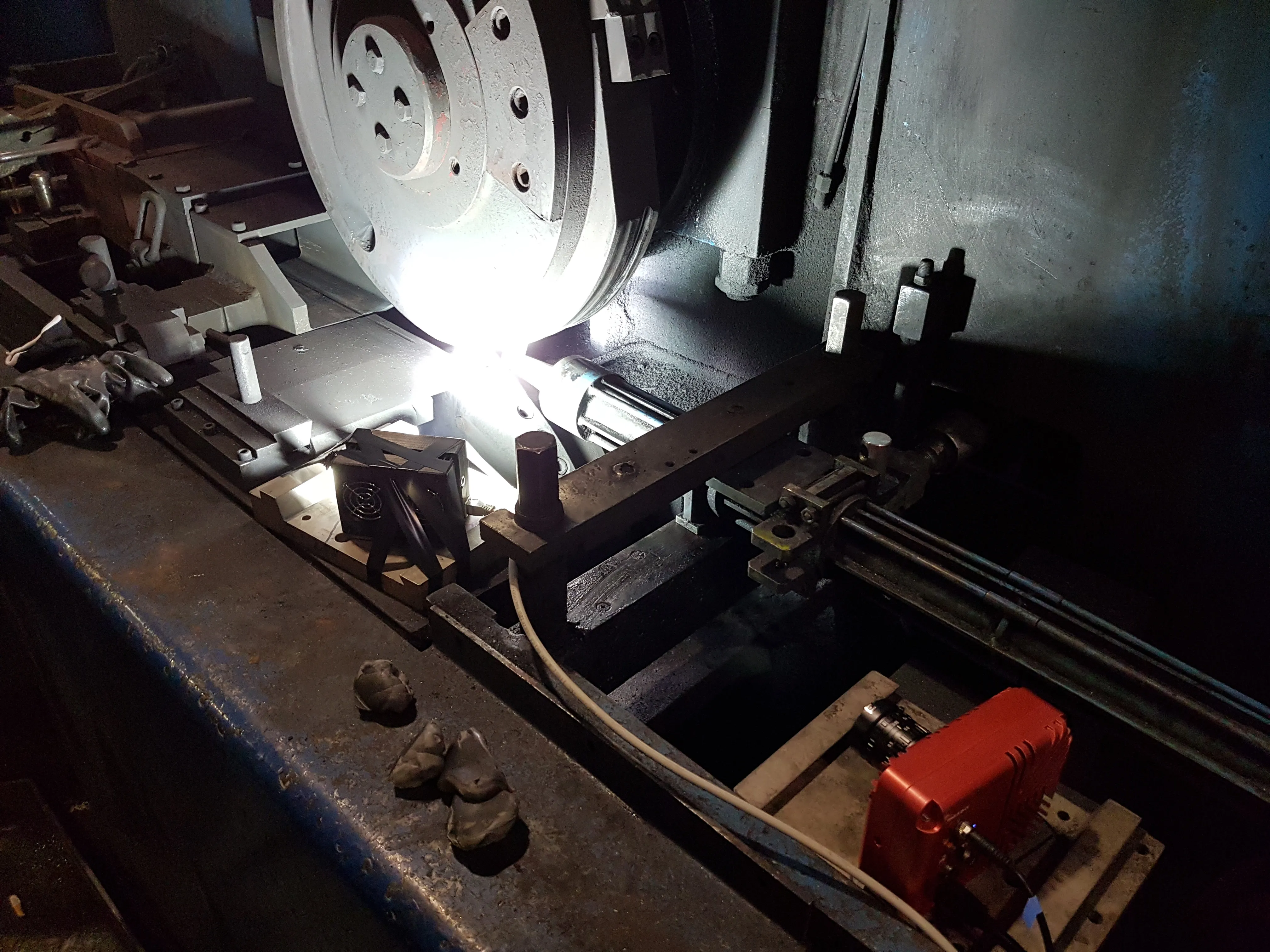 Documented deployment Photo: demonstration on a high-speed shear
Demonstrated results — industrial deployment
Steel & rolling mill process monitoring
HSCAM STREAMER 1M13 deployed for around-the-clock monitoring of a high-speed steel shear-trimming process, with synchronized measurement data acquisition. Recording is started by a photocell and runs while goods are present.
- Timing
- Video frames and measurement samples acquired on the camera’s internal 100 MHz clock
- Position
- Sub-millimeter alignment of video and measurement
- Data rate, one camera
- ~1.44 GB/s uncompressed → ~300 MB/s after in-camera compression (~5:1)
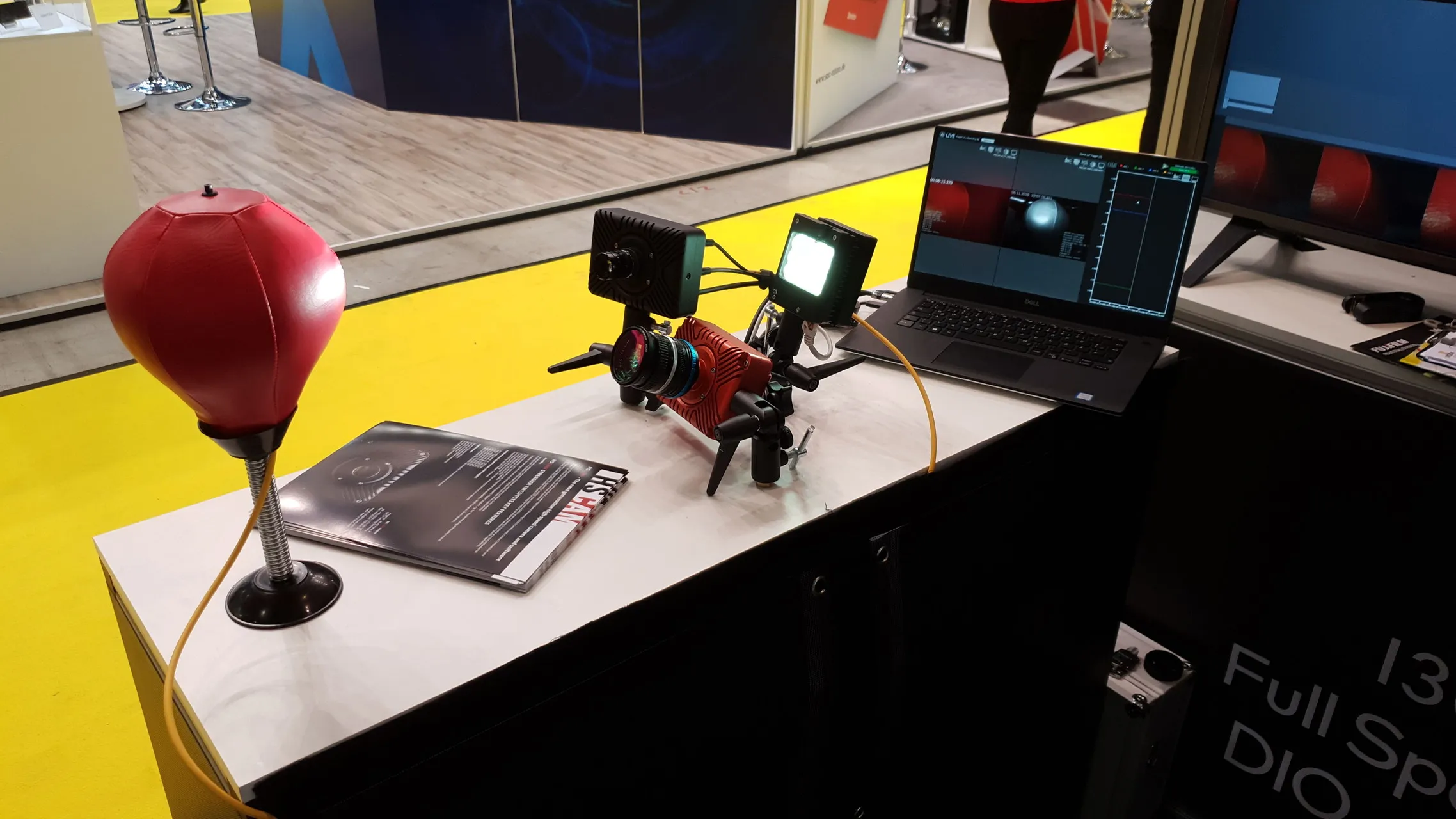 Trade-show demonstration
Demonstrated results — trade-show demo
Punching-Ball measurement fusion
HSCAM STREAMER 1M13 and 1C13 in MultiCAM mode, synchronized by exposure, triggered on an ADC threshold value, tracking a punching ball. Live HSCam Viewer software shown on-screen.
- Pre-trigger buffer
- 1 second
- Recorded at
- 1,280 × 864 px @ 1,000 fps, both cameras
Specifications
Full specifications
Grouped by what each figure describes. Figures marked as achieved in an installation were reached in a real deployment.
Frame rate and region of interest
| Specification | Value |
|---|---|
| Full frame | 1,280 × 864 px @ 1,318 fps continuous |
| Reduced ROI | 1,280 × 4 px @ 168,000 fps continuous |
| Region of interest | Variable ROI |
| Achieved in a real deployment | > 1,300 fps continuous Achieved in the steel-mill installation. |
Exposure and shutter
| Specification | Value |
|---|---|
| Shutter type | Global electronic shutter |
| Minimum exposure time | 1 µs Limited by export regulations. |
Interface and data path
| Specification | Value |
|---|---|
| Camera interface | USB 3.0, up to ~300 MB/s streaming |
| On-camera compression | Edge-preserving, adaptive, about 5:1 (typical) At 1,280 × 864 px, approximately 1,300 fps and 8 bit: ~1.44 GB/s uncompressed, ~300 MB/s compressed. The camera dynamically adjusts compression to prevent its internal buffer from overflowing; the ratio therefore depends on the image content. HSCAM Viewer shows the compression rate of each recording. |
| Host distance | Fibre-optic USB3 extension up to 150 m Used in the steel-mill deployment. |
| Housing | Industrial housing; custom housings engineered per application |
Measurement channels and synchronization
| Specification | Value |
|---|---|
| Measurement inputs | 4× 16-bit ADC (±10 V), 2× GPIO (TTL) Extendable to 20 ADC channels via the HS-DAQ accessory. |
| Timecode | Modified IRIG-B |
| Multi-camera synchronization | MultiCAM mode, synchronized by exposure Demonstrated at the Messe Vision trade fair, in the measurement setup, with a 1M13 + 1C13 pair. |
| Video / measurement timing | Frame-synchronous acquisition on the internal 100 MHz camera clock |
Operating the camera
What an installation needs around it
Requirements depend on frame rate, ROI and recording duty cycle. Tell us your setup and we confirm the host PC and storage you need.
- Host connection
- A USB 3.0 port on a standard PC or laptop. A fibre-optic USB3 extender (up to 150 m) was used to keep the PC out of a hot, impact-prone area.
- Storage
- At full resolution and approximately 1,300 fps one camera delivers ~300 MB/s after compression, so recording needs a suitably specified SSD. Recording continuously at that rate adds up to about 181 TB per week (decimal units, image data only). Triggered recording stores only the relevant periods.
- Software
- HSCAM Viewer for recording, playback and analysis; its Python scripting plugin for trigger and recording behaviour. Optional C++/OpenCL plugins for heavier processing.
- Optics and lighting
- The lens is matched to the application. The examples on this site used strobe lighting synchronized to the camera exposure.
- Sustained streaming
- Continuous streaming over USB 3.0 needs the compressed data rate to stay within the link. Frame rate and ROI are chosen together: the steel-mill installation ran at 1,000 to 3,000+ fps, depending on ROI.
Software & integration
Four integration tiers, from Python to FPGA
Recording, playback and analysis run in HSCAM Viewer. Camera and recording behaviour can be scripted in Python. The FPGA and DAQ tiers are currently integrated by HSCAM only.
| Integration tier | Latency · platform · who integrates |
|---|---|
| Python-Framework camera SDK | < 100 ms latency · PC/Laptop · customer with provided examples |
| Camera SDK integration | < 100 ms latency · PC/Laptop · customer with additional HSCAM support |
| FPGA integration | < 1 µs latency · on-camera · HSCAM only for now |
| DAQ extension | < 1 µs latency · DAQ module · HSCAM only for now |
Related
See it applied
Pilot projects
From your application to an agreed test
You describe the process and the problem. We check whether STREAMER 1M13 suits it: line of sight, speed, image area, lighting, signals and environment. If it does, we plan a limited test together with an agreed scope, time frame and cost.
-
1. Describe process and problem
You tell us what the process does and what goes wrong. A short description is enough.
-
2. Check technical suitability
Together we look at line of sight, speed, image area, lighting, signals and environment.
-
3. Plan a limited test
Scope, time frame and costs of the test are agreed together before anything starts.
-
4. Evaluate and decide
We go through the recordings with you and decide on the next step.
Scope, time frame and costs are agreed individually for each test.
Discuss your application
Tell us what you need to record or measure, or what goes wrong in your process. If frame rate and image area are not clear yet, that is fine: we help with the design and reply with questions or a suggested setup.
Helpful, but not required
- What your process does and what goes wrong, or what you cannot see today
- Speed or cycle time, if you know it
- Measurement or trigger signals that exist on the machine
- Environment: temperature, lighting, mounting space
contact@hscam.com · hscam.com